Showing posts with label Unit X - 3 Key Posts. Show all posts

Tuesday, 20 May 2014

Blog posting 3 - REFLECTION


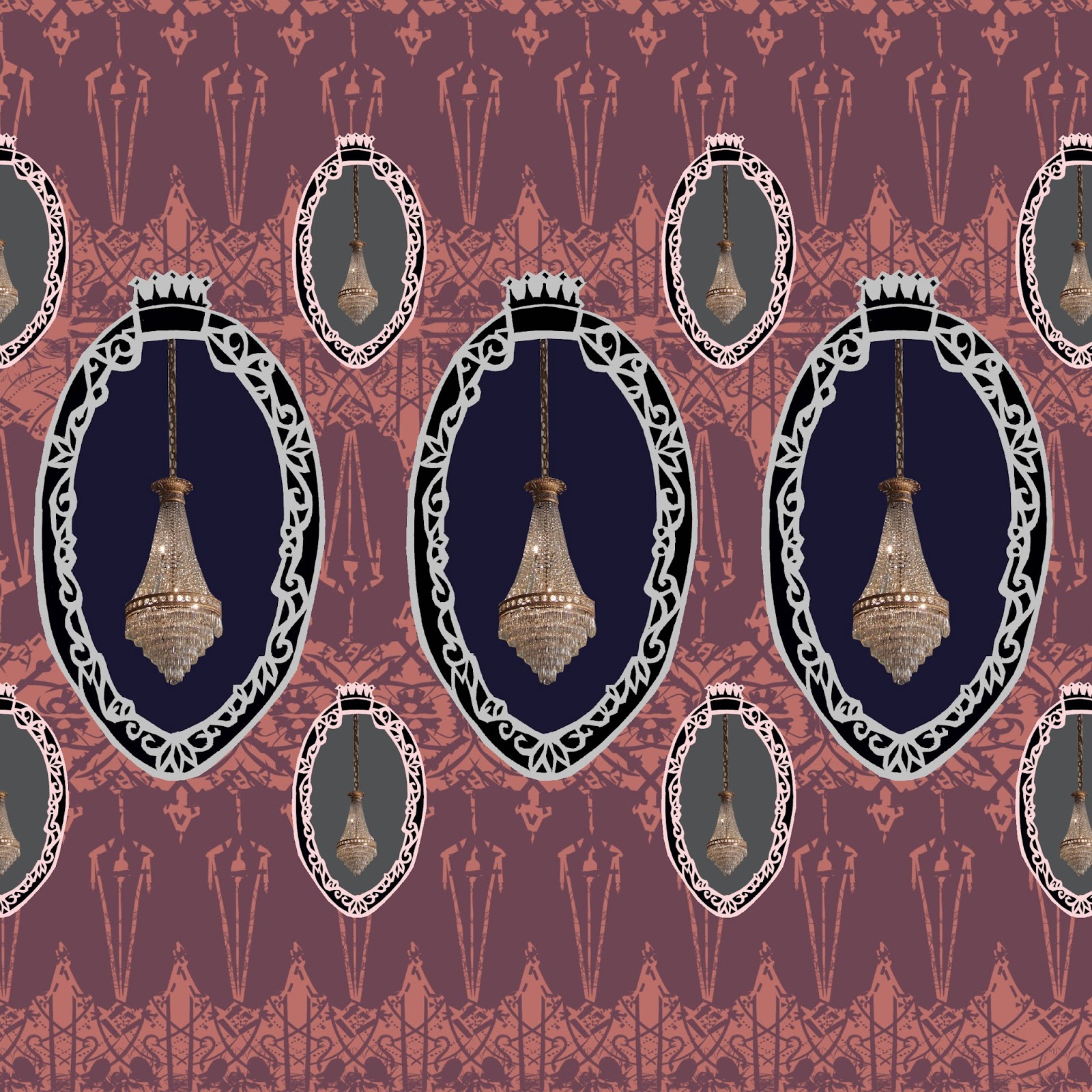
This project has opened my eyes to a world of opportunities and has led me to realise that as a freelancer the possibilities can be endless if you are open to working with other people. Before this project I would never have thought of putting my prints onto ceramics, and I feel I have learnt more about 3D design in general, which has led me to think about how my practice fits into the wider commercial design world, and considering my work outside of the confines of fashion print.

I have also discovered that varying my working routine can benefit my final product, as although it is good to have a method that works I have realised that it is also important to work in a way that suits the project – for instance, I usually stick to research, drawing, then printmaking, but in this project I started doing printmaking earlier on in the process, and then went back and did more drawing and research, which led to a more considered final product. Having never worked on such a large scale before, it was a steep learning curve understanding how my seemingly tiny prints on a computer screen would look printed full size.

I really tried to fully immerse myself in the project, as I really wanted to design a strong response to the client brief. I feel I engaged very well with my theme mainly because I did plenty of research throughout the project, so I had plenty to work from. I thoroughly enjoyed the workshop activities, as it was a great reflection on the world of networking, and the fact I got plenty of feedback from potential collaborators shows I was able to sell my ideas well. I found the mixing and changing of the tutorial groups really beneficial, as you got the input of a wider range of people, and I felt I had plenty of comments to offer in the early project stages. Even though I didn’t collaborate with anyone on the end product, I felt I always had a strong team of people around me that were involved in every stage of the design process. I was quick to offer others my knowledge, such as helping Eden with Photoshop and discussing our InDesign woes, and comparing ideas with Julia, but I also benefitted from group collaboration, such as the drawing workshop.

I think overall I made good choices when it came to my final designs; I thought hard about print placement and considered where to place images so that they were the right way up when the scarf is worn, and understood that product research was key in helping me understand this. I also think the choice to combine photographs and drawings worked really well, particularly in my illustrated visualisations, as it immediately gave the viewer a feel for the theme. I was pleased with the fabric choice, but I feel I should have done more fabric testing to prevent the colours coming out wrong in my digital prints. I also should have taken into consideration the open weave of the cotton voile and therefore avoided finer line that is easily lost.


I think I could improve upon my attention to detail within my design work, which was sometimes lacking – having never designed on such a large scale before, I didn’t quite realise how much a small mistake would be magnified on the final product. I would also like to improve upon my InDesign skills, as I attempted to create a publication but in the timescale it was too much work to do at once, so I ended up having to drop it.

Creating a coherent collection that reflected my aim to create my own baroque patterns using ambiguous objects inspired by the National Trust, was as important to me as making a saleable end product. I have discovered that I really enjoy combining unexpected items and motifs into historically inspired patterns, and this is a theme I would like to continue in future work. My other key motivation in this project was to create a product that was market ready, as I wanted to prove to myself that being a freelance print designer could be a viable option when I leave university. Thinking about the branding for example, has made me think about the product as a whole and has made me realise that I could actually see myself having my own brand in the future. 


Friday, 2 May 2014

Blog posting 2 - INVESTIGATIONS


In the past I have generally stuck to drawing and painting as a starting point for motif making, as I know it is a system that works well for me; but I have found it very beneficial taking a different approach and being more experimental early on in the project as I have created some striking imagery to work into my prints. I have learnt that it is also good to vary my content, and I think that more bold and graphic motifs contrasted with my usual softer line drawings will create some interesting prints. I really enjoyed using collage in my last project, so it has been good to further push my skills with this technique. Doing the Patternmash brief has also really helped my work, as I started to think about the layout of prints much earlier than I usually would in a project; in the future it may help to start playing around with print layouts at the same time as drawing motifs so that I can create drawings for a particular purpose, rather than my usual pattern of drawing then print making.


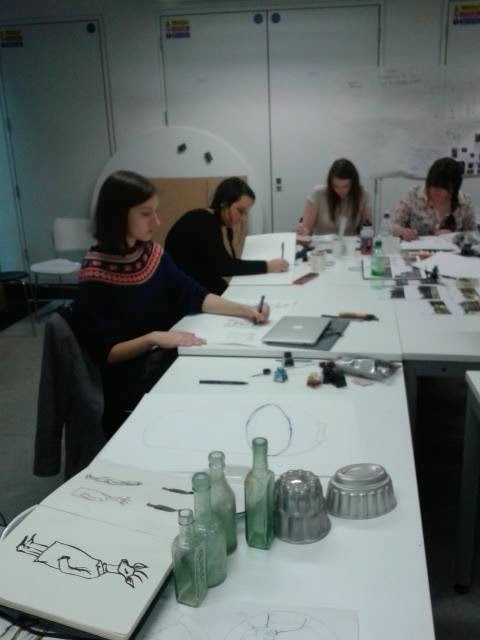
Even though I did not collaborate with anyone to create my final product, the collaborative side of the project has had a big impact on my work. The fact that there were very few other print students who picked this option meant that I’ve pushed myself to interact with students from other areas. I have found it really beneficial seeking advice and opinions from the weave students as they have a very different approach to textiles (for instance, I would usually have not have considered making my own tassels for my scarves before they suggested it), and I feel I can offer them more design based advice, such as helping Eden with her Photoshop skills. On plenty of occasions I have met up with illustration student Julia to talk through our ideas, which has been so useful to get her opinion on my work as I have a very illustrative style, and she has made me realise that there are many options out there other than just fabric-based outcomes. This is also the case with talking to the 3D design students; it has been so interesting seeing their take on the project, and even though I haven’t ended up collaborating with a ceramics student, I felt that the collaborative drawing workshop we did really helped to kick start ideas in my project. I definitely think that I would like to collaborate with students from other disciplines again as it has made me look at my own practice with fresh eyes.


I have played around with materials and drawing styles in this project, using papercuts to create lace-like patterns that could be turned into brushes on Photoshop. After playing around with different techniques I decided I wanted to reflect this strong graphic feel in my drawings, so I used pen and gouache to make drawings that looked like they could be paper cuts. Although they would translate very well as screen prints, I want to use Photoshop for its ability to really layer up stencil images with drawings, textures and photographs. 


I loved the idea of collaborating on a ceramic piece with one of the 3D design students, but discussions with tutors made me realise that it would benefit my practice to work further with scarves, and in the time scale of this project it made more sense to work with techniques that I already know to create a really slick end product. I have designed square scarves in the past but they are usually placement prints designed to focus on the corners, whereas long scarves are worn totally differently, so I want the focus of the print to be on the ends. I understand the importance of knowing my market place, so I did further research to see what type of scarves the National Trust already sell, looked at high street stores for a price range comparison, and looked at higher end brands for pattern, scale and colour inspiration, all of which has given me a clearer idea of what I think will sell well print-wise. As one of the key points of a prints success is the colour, I have spent tome putting together a colour palette that I think reflects the project, with a mix or muted and brighter colours.


I definitely want to digitally print some of my scarves to show the viewer how my prints would look in a final context, so to do so in time I have made a day-by-day plan of what needs doing so that my fabric can be printed in time for the exhibition. This means that in the next few days I really need to concentrate on creating prints so that I can swiftly move onto finalising designs. 

Friday, 28 March 2014

Blog posting 1 - RESEARCH

Research is an important part of any project, but as my work and drawings tends to include a lot of detail and collaged elements, I wanted to get lots of visual imagery to work from. I found the trip to Taton Park very inspiring, and the grandeur of the building was the key inspiration for my baroque theme. I did lots of sketches as we went round the building and I was most interested in the immense amount of detail everywhere around the house, from the architecture to the furniture and objects within the interior. The archives were very important for furthering my ideas, as it helped me to gather plenty of baroque images including gilt frames, lace work and jewellery. I was also really intrigued by the random collection of ‘miscellaneous objects’ in the archive, and would like to work this imagery into my work somehow.


One of the most important things for me in this project has been the chance to learn about other disciplines in the art school, and to think outside the realm of textiles. This is where all the lectures have been rather interesting, and very much helped with my research. I have particularly enjoyed learning more about ceramics and 3D design, and would like to see how techniques and ideas can be applied to my own textiles prints. It has also been very interesting discussing ideas with students from other courses, such as illustration and 3D design, as it has helped me to look at how I research and work in a different way. I was surprised at how interesting I have found the content of the 3DD course, and would be interested in working with them in the future – I really love the finished quality of glass and glazed ceramics. My research into the products that the National Trust shop sells has also been integral, as its important to see what they already sell so that my product is suitable but also fills a gap in their product range.


I already knew of Paul Scott’s work, but I found his talk extremely inspiring in the way that he talked about historical blue and white plates, and the amazing patterns involved. I already use a lot of collage in my work, but I liked the way Scott blended motifs together in such a coherent manner by using all one colour or line style – something I would like to reflect in my own designs. From looking at collage in a baroque sense, I looked back at the work of Timorous Beasties to bring my research back to my practice, and think about how traditional and more modern imagery could be combined in a print. All the detailed lace in the archives made me think about using my paper cutting skills, and led me to research into the intricate paper works of Andy Singleton and Elsa Mora.


It would be very easy for me in this project to just do drawings and make a print collection, but I wanted to push myself and so I wish to experiment more with techniques. Talking to students from other disciplines has made me want to think in a more 3D sense, so I hope to use paper cutting and wire working techniques alongside my drawing, so help create motifs for my digital prints. I hope that working with different materials will help me to think differently about my work, and inspire me to create something innovative and new for the shop that is still inspired by the beauty and grandeur of the properties belonging to the National Trust.